
How to Pace Spin Intervals Without Burning Out

The chorus drops, the room gets louder, and your instructor calls for a push. It is tempting to give every interval absolutely everything. But learning how to pace spin intervals is what helps you finish the ride strong, enjoy the music, and leave feeling proud instead of completely wiped out.
Pacing is not about holding back. It is about choosing the right effort for the right moment. Some intervals should feel spicy. Others should feel smooth, controlled, and almost surprisingly manageable. When you know the difference, you can Smile, Sweat, Sing, and still have something left for the final song.
Start With Effort, Not Perfection
Spin bikes do not need to be a numbers game. Cadence, resistance, and power can be useful tools, but your body is the best place to start. Think of each interval on a scale from 1 to 10, where 1 is an easy cruise and 10 is an all-out effort you can only hold briefly.
For most rides, you will move among four useful zones:
Easy recovery, around 3 to 4 out of 10: You can take a full breath, relax your shoulders, and speak in short sentences.
Steady work, around 5 to 6: You are working, but you are not bracing for survival. This is where control and rhythm live.
Hard effort, around 7 to 8: Your breathing is heavier and talking becomes difficult, but your pedal stroke stays smooth.
Short push, around 9: This is for brief surges, sprints, or a big final climb. It is powerful, not messy.
A 10 is rarely necessary in a regular class. Save it for a true test, not every beat drop. If you go maximum effort during the first interval, the rest of the ride becomes about recovering from that choice instead of riding with the room.
How to Pace Spin Intervals Through a Full Ride
The simplest pacing rule is this: begin one notch easier than you think you need to. Your first working interval should feel like an introduction, not a final exam.
Give yourself the first few minutes to settle into the bike. Find enough resistance that your legs feel connected to the pedals, then build your rhythm. A good setup matters because spinning too fast with very little resistance can make you bounce in the saddle and lose control. On the other hand, loading on too much resistance too early can turn every song into a grind.
During the first hard interval, aim for a 7 out of 10 effort. You should feel challenged, but able to match the requested duration without panicking halfway through. If the interval feels too easy at the end, add a small amount of resistance or pick up your pace on the next round. Small adjustments are smarter than dramatic ones.
As the ride progresses, the goal is not necessarily to make every interval harder. The goal is to make each one appropriate. A 30-second sprint may call for faster legs and moderate resistance. A hill may call for heavier resistance and a slower, stronger pedal stroke. The music may change, but the question stays the same: can I hold this effort with good form until the interval ends?
When the instructor gives a recovery, take it. Recovery is part of the workout, not a sign that you failed the last push. Ease the resistance slightly, let your heart rate come down, and take a real breath. Riders who respect recovery tend to produce better work in the next interval.
Let Cadence and Resistance Work Together
Pacing gets easier when you stop treating speed and resistance as separate challenges. They are a pair.
For a faster flat or sprint, use enough resistance to feel stable, then increase your leg speed without bouncing. If your hips start shifting side to side or your feet lose control, slightly reduce cadence or add a little more resistance. Fast is only useful when it is controlled.
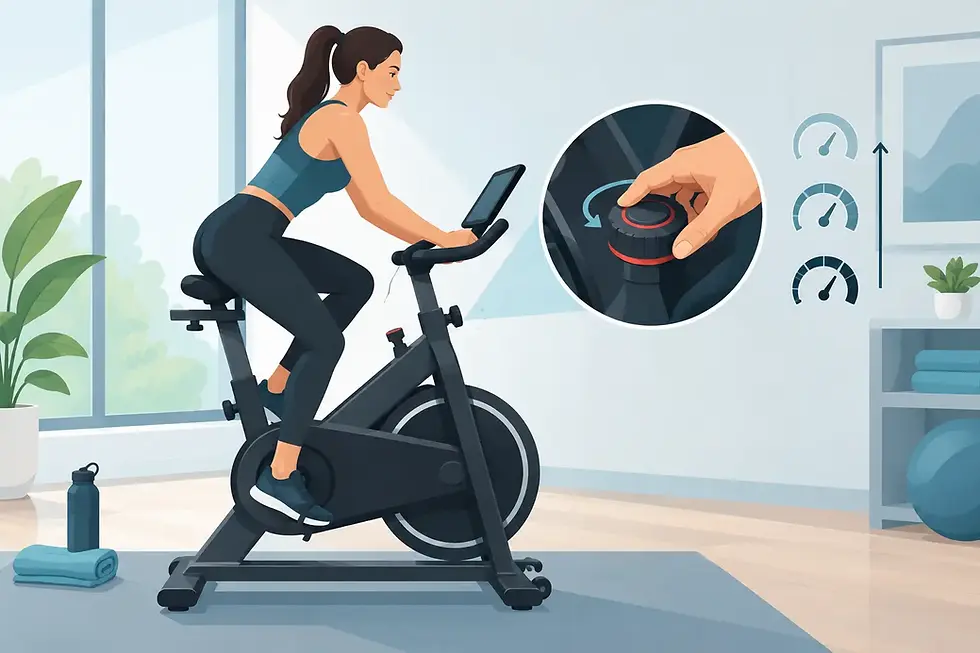
For climbs, increase resistance in small turns and let cadence naturally slow. You should feel pressure through your legs, but you should still be able to keep the pedals moving in circles. If your stroke becomes a series of jerks or you need to yank on the handlebars, the resistance is likely too heavy for that moment.
Out-of-saddle efforts add another layer. Standing can feel exciting, especially when the beat is big, but it costs more energy than sitting. Keep your body tall, core supported, and hands light on the bars. If standing makes your breathing jump from hard to frantic, sit down, reset, and continue the effort from the saddle. No pressure. A strong seated climb is still a strong climb.
Use the Talk Test When the Room Gets Loud
Music-driven rides are built for getting caught up in the moment. That is part of the fun. Still, your breathing gives you honest feedback when the room is buzzing.
At a steady effort, you should be able to say a short phrase. At a hard effort, you may manage only a few words. During a sprint, talking is not happening, but you should recover quickly once the sprint ends.
If you cannot catch your breath after a recovery section, lower your resistance a touch or slow your legs down for longer than you planned. This is especially useful for newer riders, anyone returning after time away, or anyone riding on a low-energy day. Matching the class does not mean copying every setting or every movement. It means riding the intention of the interval in a way that works for your body.
Plan Your Pushes Before You Need Them
A little strategy keeps you from spending all your energy too soon. Before class, decide on one or two moments where you want to challenge yourself. Maybe it is the final hill. Maybe it is holding your pace for the full duration of a repeat sprint. Maybe it is staying seated with calm shoulders during a tough song.
Then give yourself permission to ride the earlier intervals at an effort that supports that goal. This does not make the ride easier. It makes your effort more intentional.
On days when you feel fresh, you might gradually build from a 6 or 7 early in class to an 8 or 9 near the end. On days when stress, sleep, or sore legs are in the mix, holding a consistent 6 or 7 can be the win. Fitness is not proven by suffering through every session. It grows through repeatable work.
Watch for the Signs You Started Too Hot
Everyone has had a ride where the first song felt amazing and the third song felt impossible. Usually, that is a pacing issue, not a toughness issue.
You may have started too hard if your legs burn intensely before the class is properly underway, your form falls apart, or recoveries do not bring your breathing back under control. You may also notice yourself avoiding resistance because your legs are already overloaded. When that happens, reset rather than quit. Sit down, reduce resistance slightly, focus on a smooth pedal stroke, and rebuild from there.
The same goes for chasing another rider's settings. Their bike, fitness level, and ride history are not yours. Use their energy as motivation, not a measuring stick. The best kind of group ride is one where everyone brings their own effort to the same room.
Make Every Interval Feel Like a Choice
The most satisfying spin intervals are not the ones where you barely hang on. They are the ones where you feel present enough to hear the song, hit the beat, and choose when to push.
Start controlled. Build with purpose. Recover without guilt. Then, when the moment is right, turn the dial and enjoy that strong, sweaty finish. Your ride does not need to look perfect to feel powerful.


Comments